For a stretch last year my job was to make phone calls. Arrive at the desk, open the list, dial one by one. Eighty to a hundred a day on average. Getting hung up on was normal; when someone did answer, the conversation often lasted less than three sentences.
I did the maths afterwards: roughly 2,700 calls, three deals. By commission, each call was worth about one yuan.
It is not a nice number. But it made me ask a question I had not asked before: of everything I do all day, what is actually left behind?
One yuan per call
The call itself leaves nothing. This one ends, the next starts from zero. The script does not improve because I dialled a hundred more times. The customer does not remember me because we had a pleasant chat.
This is linear labour: time traded for a result that stops when you stop. Delivery, customer support, most sales — same model. It is not that the work is not hard. It is that the hardness does not accumulate.
I have seen harder work. People on construction sites swinging hoes all day are more tired than I am. The difference is not effort. The difference is that their swing ends and nothing is left, while at least I could write down what I had learned on the phone.
So after those three months, the first thing I did was not make more calls. It was reorganise the script.
One-off work and reusable work
I started dividing work into two kinds.
One-off work disappears when it is done. Reusable work can be used again.
Calling customers, done naively, is one-off. But if I collect the common objections, the moments where customers hesitate, and the scripts that actually worked into a tree, then the next person — or me next month — can use it directly. Now it is reusable.
I keep two evenings a week for this. I take the repetitive parts of sales and turn them into tools: customer info looked up automatically, script templates filled in automatically, follow-up records filed automatically. None of it is pretty, but the time saved is real.
Right now I have a few small tools: a local customer-data organiser, a script generator, a small script that files call records. Nothing big. Together they save half an hour to an hour a day.
Three kinds of leverage
I can explain three so far.
- Intellectual leverage: maths, logic, understanding complex systems. Learn once, use for years.
- Cognitive leverage: a knowledge base, principles, reviews. Every pitfall gets written down so it is not paid for twice.
- Technical leverage: code written once runs many times; a tool built once gets used again.
What they share is: invest once, produce many times. Work that trades time directly for money is one to one, or at best one to 1.2.
I did the time maths too. Eight hours of calls produce eight hours of results. Two hours of building tools produce zero in the first month, and by the third month they save half an hour a day. The first pays immediately. The second makes you wait. Most people understand the logic; they cannot afford the wait.
Why a job is linear
The essence of a job is selling time wholesale to an organisation. Income equals time times rate. The ceiling is your time, and time has a ceiling.
Worse, some experience is only valid inside one company. Change the environment and the processes, relationships and context change too. The experience is discounted.
I have seen salespeople with ten years of experience change industries and perform worse than newcomers. Their ability did not degrade. The things they knew did not travel.
So I now try to write experience into things that can travel: scripts, processes, checklists, tools. Before it is written down it lives in my head. After it is written down it is actually mine.
Does any of this mean jobs are bad? No. A job is cash flow, and the fastest way to understand how an industry actually works. But if all your energy stays there, after a few years the only thing you have is seniority.
What I’m building
Two things.
First, make the paid work itself reusable: write the process down, build the tool, hand the repetitive actions to code. Second, put a slice of time into things with no short-term return: writing, maths, my own small tools.
Neither gives feedback in the short term. An essay nobody reads. A tool nobody uses. I still think they are worth more than two hundred more phone calls.
Compounding has a cost
This logic sounds correct, but it is tiring to execute.
Tools, essays, maths — all of it happens at night and on weekends. After eight hours of calls, sitting down to write code is not efficient. A few times I wrote until one in the morning and was useless at work the next day.
People have asked what the point is. I did not have a good answer. In the short term there is no point, and I am even losing sleep.
So I reduced the volume. Two evenings a week, two hours each, no late nights. Slower is fine. Not stopping is what matters.
I know people who go home and lie down and are perfectly happy. Different choices, nothing wrong with either. I just get more anxious when I do nothing.
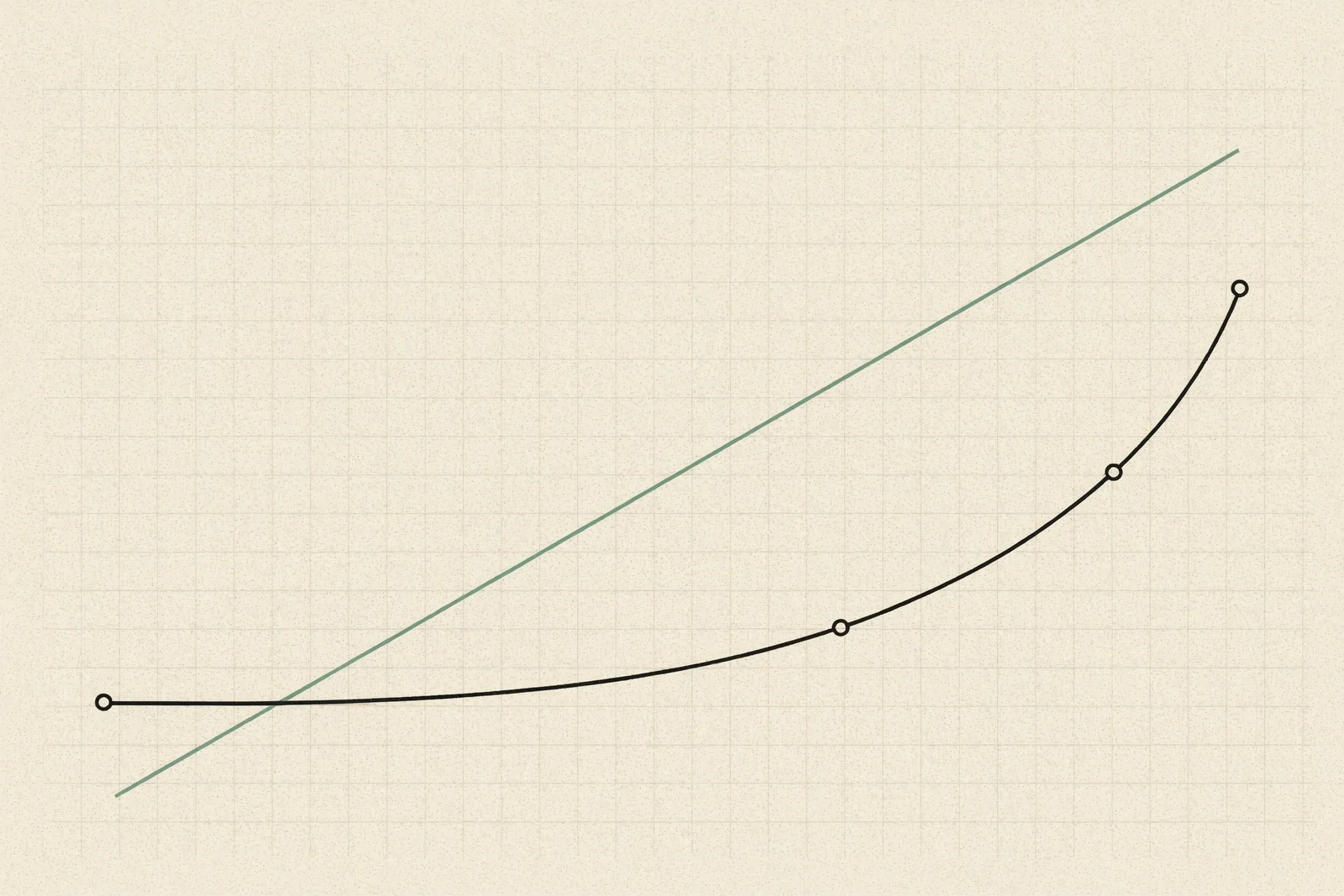
Hard work alone does not compound. Only work that can be reused compounds.
Last
I do not know whether this works out. Maybe in six months the tools are unused and the essays unread.
But I am trying to move my time from “sold once” to “sold many times”. That maths works out better than one yuan per call.
The tools are still rough. Some only I can use. That is fine. Build it first, improve it later. Tools, essays, maths — they all arrive slowly.